


AI Is Driving Change, but the Hard Decisions Are Still Human
Law firm COOs discuss the staffing, governance, profitability and investment decisions shaping the next generation of law firms.
In July 2026, Western Alliance Bank hosted a group of law firm Chief Operating Officers in our New York office for a roundtable discussion built around the findings of the 2026 Blickstein Group Law Firm COO Survey. The session brought together senior operational leaders from a variety of firms for a candid discussion conducted under the Chatham House Rule about what’s changing inside law firms and what may need to change next.
While the discussion covered a range of topics reflected in the survey data, one theme surfaced repeatedly: AI is accelerating the need to address longstanding questions around staffing, profitability, compensation and governance.
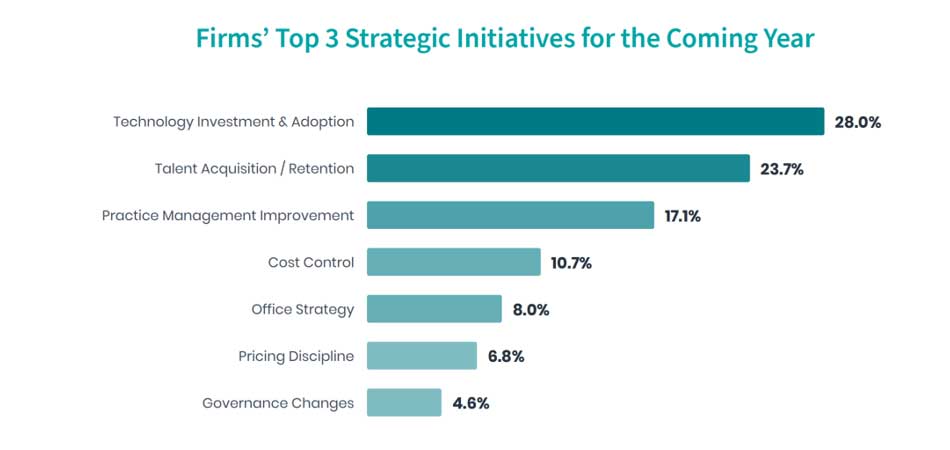
Source: Top Strategic Infinitives for Law Firms, 2026 Blickstein Group Law Firm COO Survey
Headcount: A Changing Mix
Survey data suggests a potential contraction in administrative headcount, with 9% of respondents expecting increases and 28% expecting decreases. Roundtable participants generally agreed with the overall direction but expected the composition of administrative teams to change.
Several noted that while certain traditional roles may decline, others are likely to emerge. The conversation pointed to a shift in mix rather than a straightforward reduction: fewer billing administrators, for example, but more roles tied to technology, data and AI enablement. In that sense, the question may be less about “how many” and more about “what kind.”
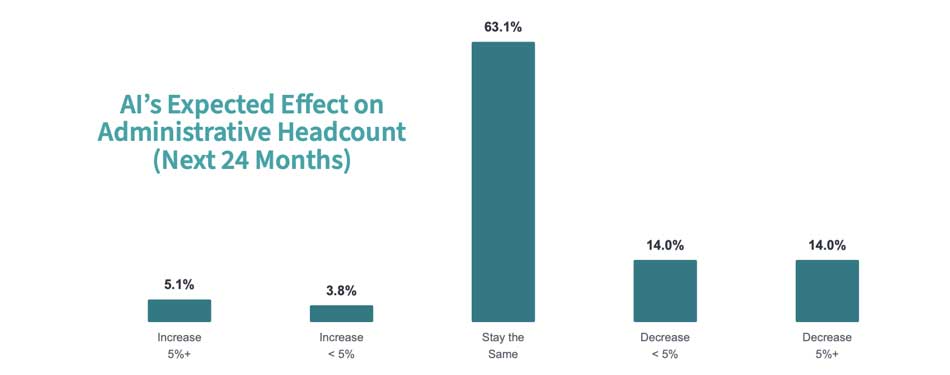
Source: Expected Impact of AI on Administration Headcount, 2026 Blickstein Group Law Firm COO Survey
Profitability Depends on Strategic Consensus
The survey identified talent capacity as the leading constraint on profitability, cited by 35% of respondents. The second most common response, at 15%, was a lack of strategic consensus. While participants generally agreed that additional legal talent would enable firms to take on more work and increase profitability, much of the discussion centered on that second finding.
Participants observed that many firms continue to bring together partners at different stages of their careers, with different priorities, incentives and visions for the future of the firm. Law firms have never been especially good at "rowing in the same direction," but as AI and other market forces accelerate change, firms may find it increasingly difficult to build consensus around strategy.
Several participants also noted that these differences often extend to how partners define profitability itself, making it more difficult to align compensation, technology investments and other strategic decisions.
Strategic Investment
Technology investment, particularly in AI, was widely viewed as the most significant strategic initiative facing firms today. Participants expect technology investment to accelerate as firms seek greater returns from AI while facing growing pressure to demonstrate ROI to firm leadership and clients alike.
Participants highlighted two related trends. First, AI platforms are expected to move more fully toward consumption-based pricing models, raising questions about how costs will scale as usage grows. Second, firms are beginning to consider the magnitude of required investment. Participants cited Kirkland & Ellis' reported $500 million AI investment as an example of how rapidly expectations around technology spending are changing.
These pressures raise a fundamental question: where will the capital come from? For some firms, that may prompt consideration of outside investment or alternative capital structures.
The Measurement Gap
Despite significant investment and attention, few firms are yet formally measuring efficiency gains from AI.
At the same time, clients are beginning to ask more direct questions about savings and value. While those inquiries remain relatively early, participants acknowledged that firms will need to develop more robust answers. The ability to demonstrate efficiency gains is likely to become increasingly important.
Survey data supports this forward-looking perspective: nearly half of respondents expect AI to have a positive impact on firm revenue over the next 24 months. That expectation is consistent with the view that capacity constraints remain a limiting factor. Over time, however, firms may face more fundamental questions about how work is priced and delivered, particularly if technology materially changes the relationship between effort and output.
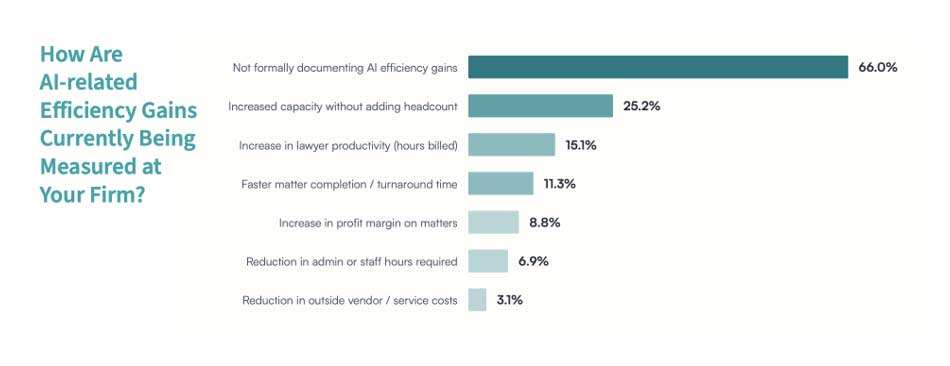
Source: How Firms Are Measuring AI Efficiency Gains, 2026 Blickstein Group Law Firm Survey
While the conversation began with AI, it quickly became clear that the discussion was really about managing change. As firms invest in AI and other technologies, they will need to make difficult decisions about staffing, governance and profitability. They may also need to rethink how those investments are funded and how capital is allocated across the firm.
To explore these findings in greater detail, download the complete 2026 Blickstein Group Law Firm COO Survey. Western Alliance Bank looks forward to continuing these conversations as the legal industry navigates this period of rapid change.
Learn more about Western Alliance Bank's Juris Banking Group.

About Us
Western Alliance Juris Banking Solutions
Western Alliance Juris Banking Solutions, a national banking group within Western Alliance Bank, Member FDIC, brings together a full range of legal industry services and expertise under one umbrella, including Full-Service Juris Banking, which offers creative, full-service banking solutions for modern law firms and legal technology providers; Settlement Services for class action, mass torts and bankruptcy attorneys, claims administrators and related businesses; Bankruptcy solutions for court-appointed trustees, debtors in possession, receivers and fiduciaries; and Digital Disbursements to facilitate payments to claimants in these matters. The Juris Banking Group is part of Western Alliance Bancorporation, which has more than $90 billion in assets and has ranked as a top U.S. bank by American Banker and Bank Director since 2016. With significant national capabilities, the Juris Banking Group delivers the reach, resources and deep industry knowledge to help businesses capitalize on their opportunities to solve today and succeed tomorrow.